Editor's Note: We invite our GCI partners to contribute blog posts on the latest happenings at their organizations related to the Grand Challenges Initiative. Read on to learn how the Institute of Fluid Science (IFS) at Tohoku University in Japan is addressing Grand Challenges in Climate Change and Digitalization, Artificial Intelligence, & Cybersecurity. Huge thanks to Samuel Manzello for writing this GCI blog entry!
Recent Updates on Wildland-Urban Interface (WUI) Fires from Institute of Fluid Science (IFS), Tohoku University, Japan
By Guest Contributor: Samuel L. Manzello, PhD
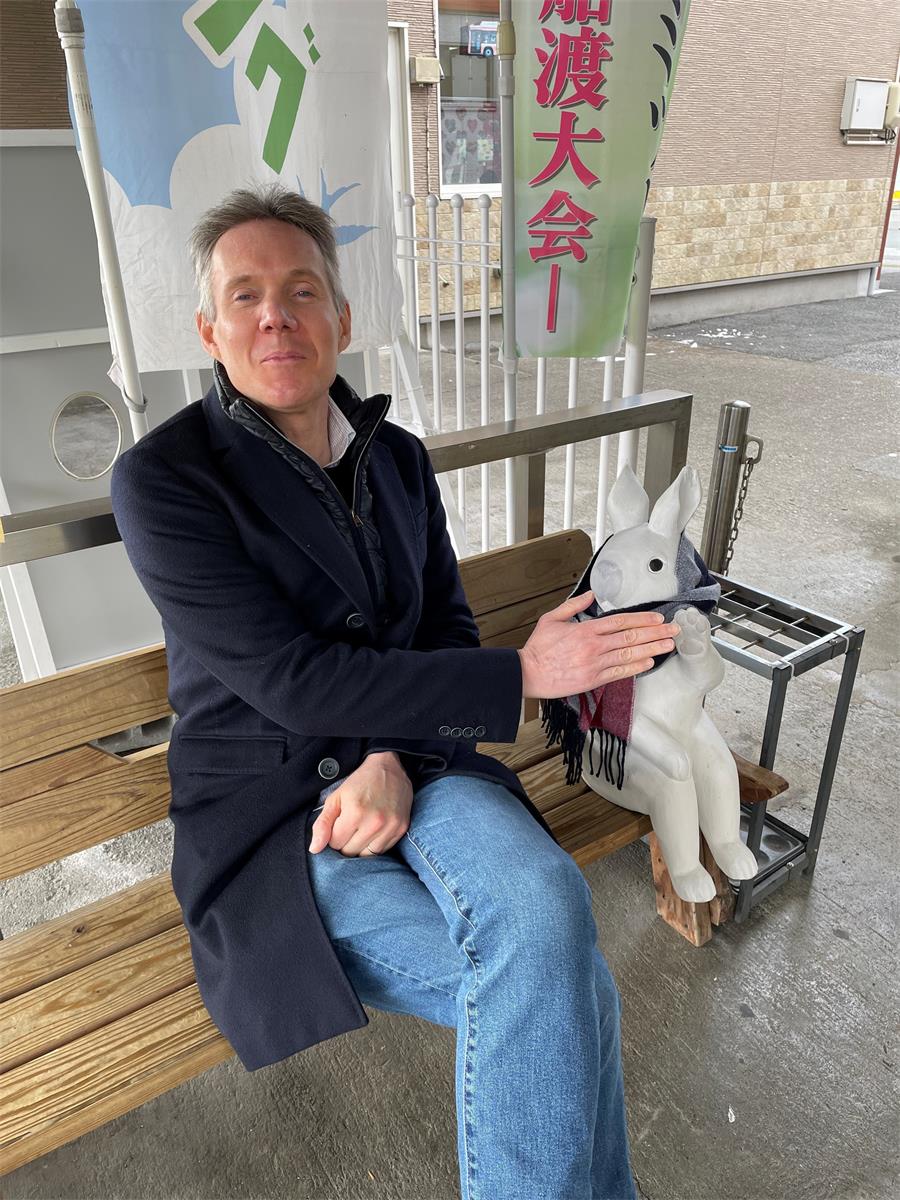 The author in Ofunato.
The duties of researchers at the European Commission Joint Research Center (JRC) are to conduct research in many fields to provide independent advice policymakers (Joint Research Centre). Established under the Euratom Treaty, the JRC has extensive expertise in the nuclear field, but offers scientific competences from a wide range of disciplines to support almost all EU policy areas. In recent times, the JRC has coordinated an expert network on Fire Safety Engineering.
In November 2025, the report Prospects for Implementation of Fire Safety Engineering Approach in Europe was published. Due to the increasing wildland-urban interface (WUI) fire problem, this report added an entire section on standardization needs for WUI fires. I was appointed as a member of the JRC expert network in 2025, and contributed progress from ISO TC92/WG14 (Large Outdoor Fires and the Built Environment Working Group)¬. I serve as convener of ISO TC92/WG14 and our working group is developing international standards for WUI fires. Included in the report is a discussion on the ISO 6021:2024 - Firebrand generator, the first international standard to generate firebrand showers.
The above report has been cited in the Staff Working Document SWD(2025) 1053 “Understanding the housing crisis” accompanying the first European Affordable Housing Plan issued by the European Commission in December, 2025. The SWD is an important policy document and it considers fire protection as a major aspect in the difficulty balancing the objectives of affordable, sustainable, and quality housing. Tohoku University recently featured this as university wide news in the article, From Japan to Europe: Strengthening Global Preparedness for WUI Fires.
WUI Fires Know No Geographical Bounds
The WUI fire problem has now come to Japan as well. With the recent 2025 Ofunato WUI fires, 3,370 ha were burned, representing the largest burned area in 61 years. The WUI fire claimed one life and destroyed 226 structures. With wildland fires burning extensively North of Tokyo in 2026, Japan needs to be prepared for the continued dangers of WUI fires. These recent fires did not spread into communities and become WUI fires but the danger to Tokyo is real.
Most recently, an invited perspective paper, solicited by Fire Technology, the official journal of the Society of Fire Protection Engineers (SFPE) and NFPA, and was published on the Ofunato WUI fire disaster in Japan, The 2025 Wildland-Urban Interface (WUI) Fire Disaster in Ofunato City, Japan.
Current Standardization Activities in ISO TC92/WG14
For interested readers, the following activities are now ongoing in ISO TC92/WG14:
The most recent item added, after approval by global ballot in April 2026, is for ISO/T92/WG14 to develop a technical specification for Modelling Approaches for Large Outdoor Fires. As part of this effort, existing models for large outdoor fires will be reviewed that purport to be able to predict fire spread for wildland-urban interface fires, urban fires, including post-earthquake urban fires, and informal settlement fires. The resulting literature review will be used to develop a technical specification for large outdoor fires models that may be used in the event of future large outdoor fire disasters. A technical specification, at the international level is required to be able to assess and compare fire spread models across all these large outdoor fire types.
Most Recent Research Findings
Our most recent research has been published in Fire Safety Journal, Prediction of firebrand transport using machine learning and physics-constrained neural networks. As indicated above, for several decades an extensive series of unique experiments were conducted using firebrand generators and these findings are being used to train advanced models needed for WUI fires.
Another recent study provides direct application of the ISO Firebrand Generator to generate firebrand showers from disparate fuels, to represent the combustion of structural and vegetative fuels simultaneously: Experimentally producing firebrands showers from disparate fuels to represent the combustion of structural and vegetative fuels simultaneously. I was honored to have our paper appear as part of an invited special issue on women in combustion in Applications in Energy and Combustion Science, with my collaborator, and co-developer of the ISO firebrand generator for past 15 years, Professor Sayaka Suzuki of Institute of Science, Tokyo!