Introduction
Climate change is making extreme weather events more frequent and more intense. Torrential downpours that were once considered “once-in-a-century” events now occur much more often. For example, in 2024, Shenzhen in southern China recorded 70 days of local heavy rainfall, accounting for nearly 19% of the year. The Intergovernmental Panel on Climate Change (IPCC), in its Sixth Assessment Report published in 2022 [1], has already confirmed that extreme weather events such as extreme temperatures and heavy rainfall are becoming increasingly common worldwide.
At the same time, urban transportation networks are expanding rapidly. Tunnels, as a crucial component of transportation infrastructure, offer significant convenience by reducing traffic congestion and shortening travel times. However, fires in these confined structures are particularly dangerous because of limited evacuation routes and challenging firefighting conditions. Examples of tunnel fire accidents include:
· Mont Blanc Tunnel Fire Accident, France, 1999: 40 fatalities, structure damaged, 3-year closure.
· Gotthard Tunnel Fire Accident, Switzerland, 2001: Over 1000 ℃ recorded in site, tunnel roof collapse.
· Yanhou Tunnel Fire Accident, China, 2014: 41 fatalities, vehicles burned, 73-hour fire.
· Miaoliling Tunnel Fire Accident, China, 2019: 5 fatalities, economic losses over 5 million RMB.
An increase in heavy rainfall frequency has caused an increase in the likelihood of tunnel fire occurring during such weather conditions. Once heavy rainfall coincides with a tunnel fire, the situation becomes more complex. Could rainfall alter the behavior of flames and smoke? Could it interfere with smoke control systems? To address these questions, we conducted scale-model experiments and numerical simulations to investigate how heavy rainfall influences tunnel fires. The results show that heavy rainfall can significantly change airflow patterns inside tunnels, thereby reshaping fire and smoke behaviors.
Rainfall-Induced Airflow: Insights from Experiments
At first glance, rainfall and tunnel fires may seem unrelated. Yet scale-model tunnel experiments in our laboratory revealed a critical interaction through an artificial rainfall simulator. We discovered that intense rainfall outside one tunnel portal creates a pressure difference between the two portals, which drives airflow inside the tunnel. A schematic of the reduced-scale tunnel experiment with rainfall simulation is shown in Figure 1.
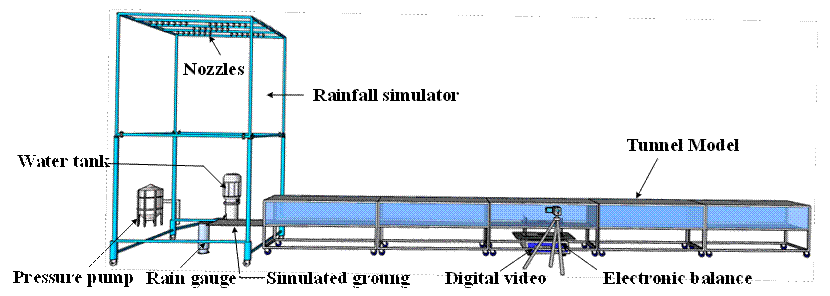
Fig. 1. Schematic of the reduced-scale tunnel experiment with rainfall simulation.
Here’s how it works: As raindrops continuously fall, the local ambient pressure of the rainfall-exposed portal increases, generating a downward expansion airflow. At this portal, the dissipation of the expansion airflow induces longitudinal airflow into the tunnel, while the resulting pressure difference pushes air from the rainfall side toward the non-rainfall side [1]. The driving mechanism of the rainfall-induced airflow is shown in Figure 2.
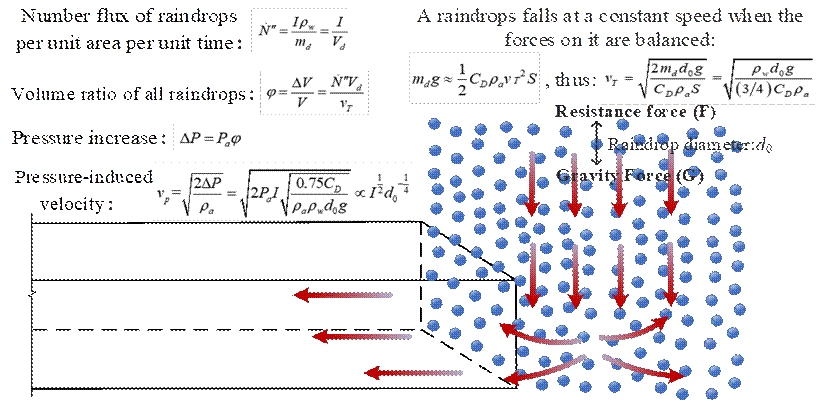
Fig. 2. Driving mechanism of airflow induced by rainfall.
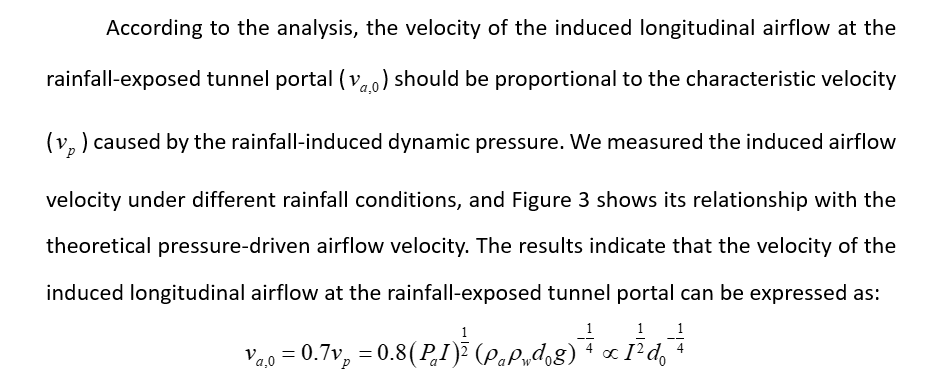
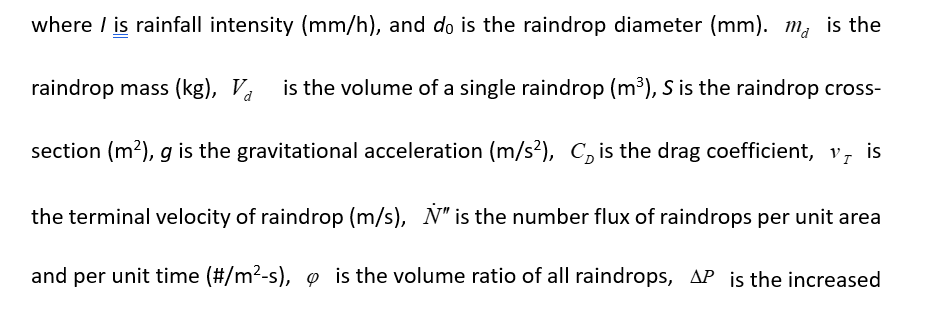

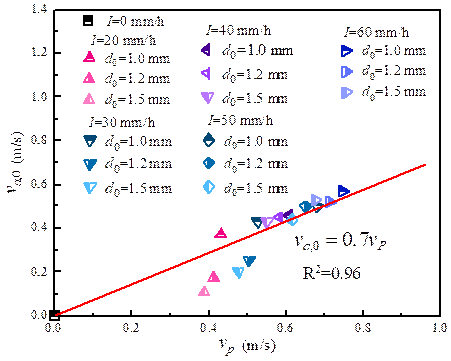

Thus, the induced airflow velocity is positively correlated with the 1/2 power of the rainfall intensity (I) and negatively correlated with the 1/4 power of the raindrop diameter (d0). In other words, the heavier the rainfall and the smaller the droplets, the stronger this rainfall-driven airflow becomes.
This rainfall-induced airflow directly alters the fire and smoke behavior in tunnel fires. Taking a heat release rate (HRR) of 2.1 kW for a fire occurring at the tunnel center as an example, the flames tilt toward the non-rainfall side (see Figure 4) [2], while the smoke on the rainfall side is suppressed (see Figure 5) [3]. The smoke stratification typically observed in tunnel fires is disrupted, causing the smoke to descend to lower levels and posing a greater threat to evacuees (see Figure 6) [3].
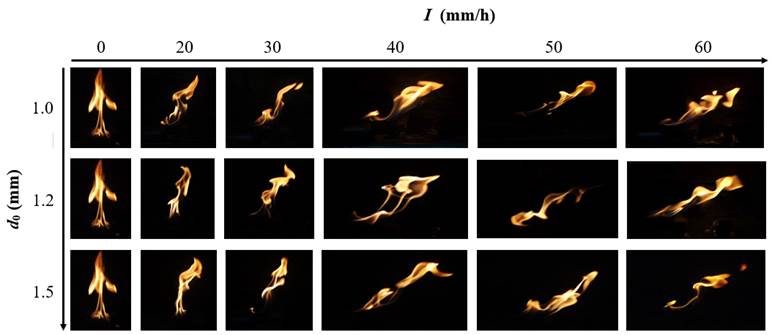
Fig. 4. Flame shape under different rainfall intensities and raindrop sizes with HRR=2.1 kW (full-scale HRR=2 MW).
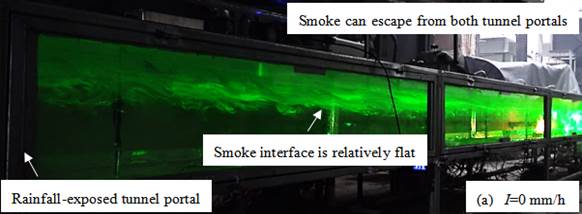
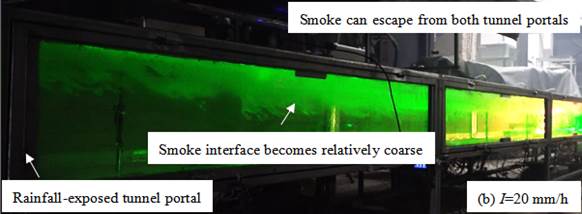
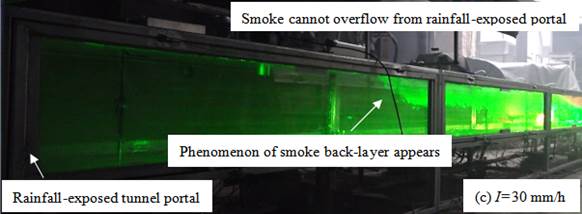
Fig. 5. Smoke spread on the rainfall side under varying rainfall conditions with HRR=2.1 kW (full-scale HRR=2 MW).
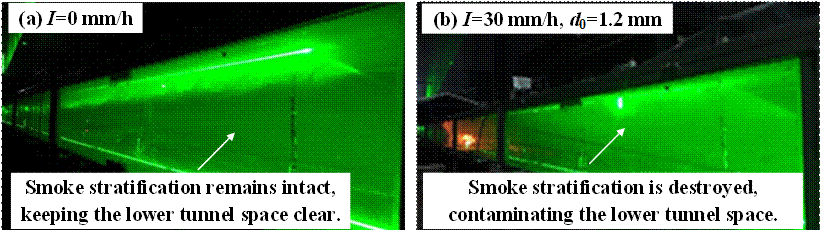
Fig. 6. Smoke stratification on the non-rainfall side with HRR=2.1 kW (full-scale HRR=2 MW), comparing (left) no rainfall and (right) rainfall conditions.
Extending to Full-Scale Tunnel Fires: Numerical Simulations
Experiments provided valuable insights but were limited in scale. To investigate full-scale tunnel scenarios, we conducted advanced numerical simulations using ANSYS Fluent. Raindrops were modeled as discrete particles, as shown in Figure 7.
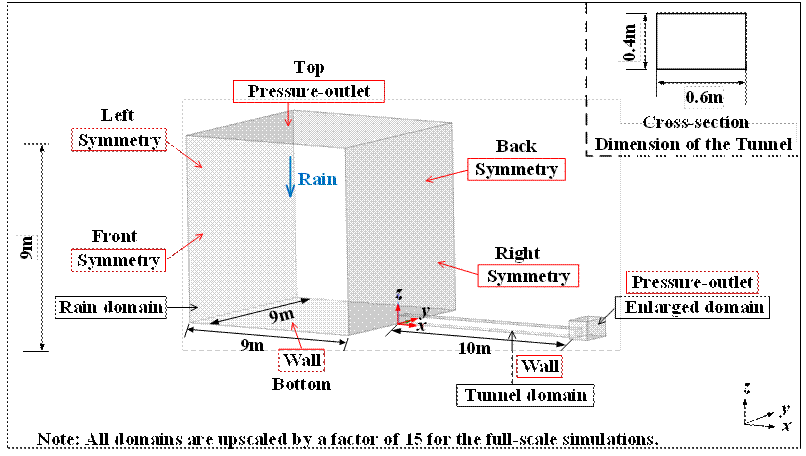
Fig. 7. Sketch of computational domains and boundary conditions.
The simulations closely matched the experimental results. Rainfall increased portal pressure and induced longitudinal airflow inside the tunnel, as shown in Figure 8 [4]. When scaled to real tunnel dimensions, the simulation results indicate that under the influence of rainfall, smoke spread toward the rainfall-side portal is hindered, and smoke stratification on the non-rainfall side is disrupted, as shown in Figure 9 [4]. Conventional smoke control systems may become ineffective or even worsen conditions if rainfall-induced airflow is ignored [5,6].
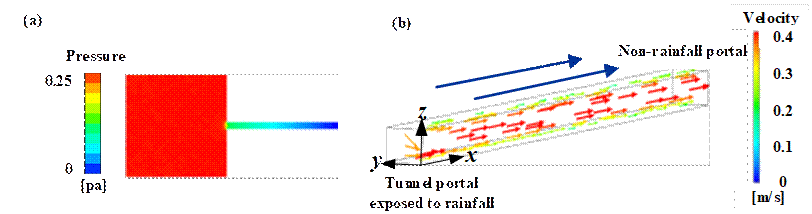
Fig. 8. (a) Pressure difference between the two tunnel portals caused by rainfall; (b) Rainfall-induced longitudinal airflow inside the tunnel (case: I=40 mm/h, d0=1.0 mm).
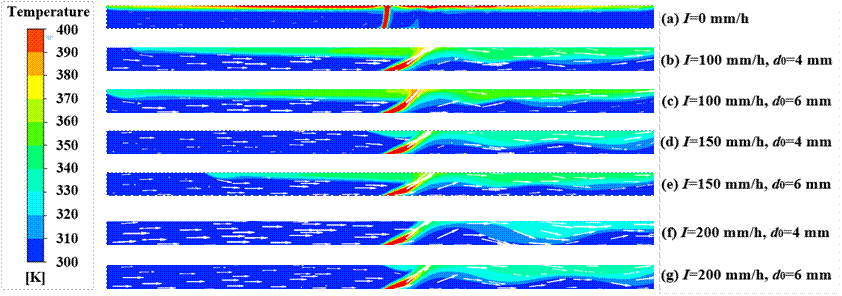 Fig. 9. Temperature and velocity fields under varying rainfall conditions with HRR=2 MW.
Implications for Tunnel Safety
Our research highlights that heavy rainfall actively reshapes tunnel fire dynamics. The key impacts include:
l Rainfall-induced airflow tilts flames and alters burning behavior in tunnel fires.
l Smoke spread is reversed, with most smoke pushed toward the non-rainfall side.
l Loss of stratification causes smoke to descend into evacuation routes.
l Conventional smoke control systems may fail under the influence of rainfall.
Summary
As climate change intensifies, tunnel fire safety can no longer be studied in isolation from extreme weather. Heavy rainfall introduces new risks by altering airflow, flame behavior, and smoke movement inside tunnels. To ensure safety, engineers must account for these combined hazards when designing ventilation and smoke control strategies, thereby ensuring that tunnels are prepared for such scenarios.
References
[1] IPCC, 2022. Impacts of 1.5ºC Global Warming on Natural and Human Systems. In: Global Warming of 1.5°C. An IPCC Special Report on the impacts of global warming of 1.5°C above pre-industrial levels and related global greenhouse gas emission pathways, in the context of strengthening the global response to the threat of climate change, sustainable development, and efforts to eradicate poverty. PP. 175-312.
[2] Fan, C., Luan, D., Bu, R., Sheng, Z., Wang, F., Huang, X., 2023. Can heavy rainfall affect the burning and smoke spreading characteristics of fire in tunnels? Int. J. Heat Mass Transf. 207, 123972. https://doi.org/10.1016/j.ijheatmasstransfer.2023.123972
[3] Luan, D., Bu, R., Sheng, Z., Fan, C., Huang, X., 2023. Experimental study on the impact of asymmetric heavy rainfall on the smoke spread and stratification dynamics in tunnel fires. Tunn. Undergr. Space Technol. 134, 104992. https://doi.org/10.1016/j.tust.2023.104992
[4] Luan, D., Bielawski, J., Fan, C., Węgrzyński, W., Huang, X., 2024. Numerical simulation of the impact of rainfall on tunnel fire. Case Stud. Therm. Eng. 62, 105186. https://doi.org/10.1016/j.csite.2024.105186
[5] Luan, D., Bielawski, J., Fan, C., Węgrzyński, W., Huang, X., 2024. Impact of rainfall on smoke dynamics in longitudinally ventilated tunnels: model-scale fire test study. J. Therm. Anal. Calorim. 150, 11667-11678. https://doi.org/10.1007/s10973-024-13575-w
[6] Luan, D., Chu, T., Bielawski, J., Fan, C., Węgrzyński, W., Huang, X., 2025. Smoke movement and stratification of tunnel fires under coupled effects of rainfall and ventilation. Fire Saf. J. 152, 104323. https://doi.org/10.1016/j.firesaf.2024.104323