
View the PDF here
A Numerical Investigation of 3D Steel-Composite Structures under Travelling Fires
By: Zhuojun Nan a, Xu Dai b, Haimin Chen c, Stephen Welch c, Asif Usmani d
a Faculty of Civil Engineering and Geosciences, Delft University of Technology, Netherlands
b School of Engineering, The University of Liverpool, United Kingdom
c School of Engineering, The University of Edinburgh, United Kingdom
d Faculty of Construction and Environment, The Hong Kong Polytechnic University, Hong Kong
This article is the short version of the published paper “A Numerical Investigation of 3D Structural Behaviour for Steel-Composite Structures under Various Travelling Fire Scenarios”.
Nan, Z., Dai, X., Chen, H., Welch, S., and Usmani, A. (2022). “A numerical investigation of 3D structural behaviour for steel-composite structures under various travelling fire scenarios.” Engineering Structures, 267:114587. https://doi.org/10.1016/j.engstruct.2022.114587
Introduction
Modern buildings often feature large open-plan compartments, where the simple assumptions traditionally made about fire exposures no longer apply. For these scenarios, the concept of a “travelling fire” has recently been advanced, where a fire is envisaged to be more localised, progressively “travelling” across a floor plate according to the balance of available fuel and oxidiser, hence providing a very different boundary condition for structural elements. Relevant theoretical frameworks include Clifton’s travelling fire model [1], the Travelling Fires Methodology (TFM) [2, 3] and its subsequent refined versions [4, 5], and the Extended Travelling Fire Method (ETFM) framework [6, 7]. These tools can be used to explore how different structural systems might respond to more complex spatial and temporal variations of fire exposures. The current study examines sensitivities of a composite steel structure to key fire parameters, as well as the fire protection specification, in order to identify which scenarios should be prioritised for design applications.
Methodology
Here, a 3D model of a prototype steel-composite structure was developed and applied under the ETFM framework to explore various travelling fire scenarios, as shown in Figure 1. Extensive parametric analysis was conducted to identify which travelling fire design parameters (such as fire spread rate, fuel load density, and opening factor) are most critical for determining the worst-case fire scenario in performance-based design (PBD), with further emphasis on the coupling effect of fire spread rates and fire protection specifications corresponding to different fire resistance ratings (FRR).
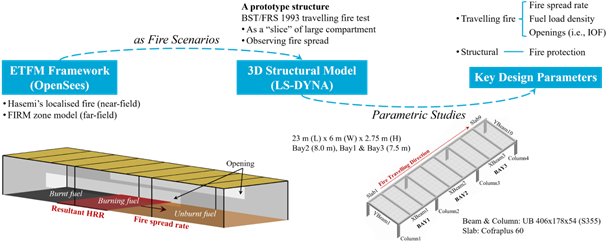
Figure 1. Research method: Exploring travelling fires for structural fire analysis.
Inspired by the BST/FRS 1993 travelling fire tests [8], a 3D model representing a “slice” of the steel-framed building with composite floors was developed in LS-DYNA, which has been validated in more detail in reference [9]. The details of the FEM setup with the corresponding structural model in combination with various FRR, under different travelling fire scenarios using the ETFM framework, can be found in the full article [9].
Results and discussion
Structural response under various travelling fire scenarios
To carry out the parametric studies of the structural response under various travelling fire scenarios, a baseline case was applied first: fuel load density 511 MJ/m2, heat release rate per unit area (HRRPUA) 250 kW/m2, fire spread rate 2.5 m/s, inverse opening factor (IOF) 9.6, total heat loss fraction 0.85, and radiative heat loss fraction 0.35. The baseline case represents a design fire scenario with a resultant HRR of 7.7 MW, and the fire duration for each bay is around 60 min. Note that all steel elements are protected to achieve at least a one-hour FRR (R60) under various travelling fire scenarios.
Figure 2(a) summarises the time-temperature histories of the beams along the travelling fire path in the model, specifically focusing on the lower flange of beams. Full heating and cooling cycles are induced by the travelling fire on the structure. In Figure 2(a), YBeam 9 in the lateral direction of the compartment reaches a peak temperature of 549 °C, nearing the critical temperature of 550 °C [10].
Figure 2(b) presents the displacement development of the 3D model under the baseline travelling fire scenario. Note that the baseline travelling fire scenario enters the cooling phase at 240 min. In general, the deflection sequence of the steel beams follows the travelling fire trajectory, i.e., as the fire travels to each beam, its deflection increases to a peak; as the fire travels away from each beam, the deflection gradually decreases due to cooling. It should be noted that the second bay, which has a slightly longer span (i.e., 8 m) has the largest deflection compared to the other two neighbouring bays with 7.5 m span.
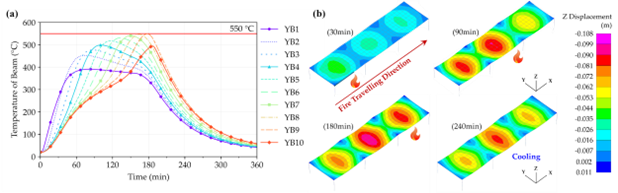
Figure 2. Structural behaviours of the model under the baseline travelling fire scenario with an FRR of R60: (a) Thermal response of YBeams; and (b) Displacement contour.
The parametric studies assess the structural fire performance under various travelling fire scenarios with different failure criteria. Table 1 shows that a single criterion cannot ensure safe structural design under travelling fires. For “slow” travelling fires, the failure of structural steel beams in cases 1 and 2 is determined by the critical temperature (550 °C) and stress utilisation (reaching to 1), respectively. The failure in case 2, caused by large tensile axial force during the cooling phase, suggests that slow travelling fires should be considered in PBD. Due to the combined effects of the concrete slab and the fire spread rate, differences in deflection and stress utilisation are relevantly small for “fast” travelling fires. Increasing fuel load densities result in higher peak steel temperatures, deflections, and stress utilisation of beams under compression. While the IOF has a limited impact on structural responses, it still directly affects the smoke layer and influences the heating and cooling phases.
Table 1. Summary of the parametric studies for the thermal and structural response and corresponding failure criteria, under various travelling fire scenarios with an FRR of R60 (cells in grey for highlighting failure).
|
Case No.
|
Fire spread rate (mm/s)
|
Fuel load density
(MJ/m2)
|
IOF
|
Critical temperature (oC)
|
Critical deflection
L/20 (mm)
|
Stress utilisation
σθ/fy, 20 ℃
|
|
Beam
(550)
|
Slab unexposed
(140+20)
|
Beam
(-300)
|
Slab
(-300)
|
Beam yield stress
(355 MPa)
|
|
Tension
|
Compression
|
|
1*
|
2.5
|
511
|
9.6
|
549
|
133
|
-95
|
-107
|
0.63
|
-0.53
|
|
2
|
0.5
|
511
|
9.6
|
503
|
121
|
-71
|
-90
|
0.93
|
-0.60
|
|
3
|
5.0
|
511
|
9.6
|
531
|
122
|
-105
|
-120
|
0.57
|
-0.56
|
|
4
|
7.5
|
511
|
9.6
|
492
|
112
|
-103
|
-116
|
0.52
|
-0.55
|
|
5
|
12.5
|
511
|
9.6
|
450
|
106
|
-104
|
-118
|
0.46
|
-0.54
|
|
6
|
2.5
|
280
|
9.6
|
443
|
107
|
-76
|
-87
|
0.54
|
-0.54
|
|
7
|
2.5
|
365
|
9.6
|
488
|
117
|
-83
|
-93
|
0.58
|
-0.53
|
|
8
|
2.5
|
730
|
9.6
|
619
|
158
|
-122
|
-135
|
0.69
|
-0.53
|
|
9
|
2.5
|
511
|
2.5
|
504
|
119
|
-87
|
-99
|
0.58
|
-0.54
|
|
10
|
2.5
|
511
|
5.0
|
523
|
124
|
-89
|
-102
|
0.60
|
-0.54
|
|
11
|
2.5
|
511
|
28.6
|
589
|
148
|
-106
|
-120
|
0.68
|
-0.52
|
* Case 1 is the baseline scenario.
Combined effect of fire protection and fire spread rates
The structure may exhibit a higher FRR than individual components due to its overall integrity. Here, parametric studies on various combinations of fire protection (i.e., equivalent FRR) and travelling fire spread rates were also conducted.
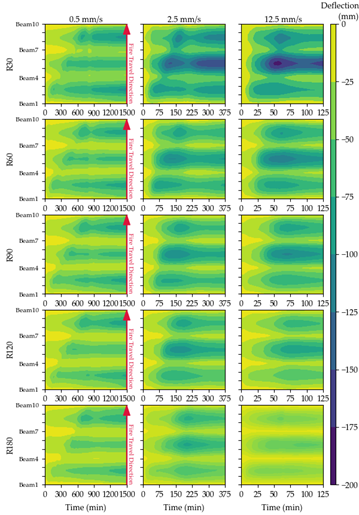
Figure 3. Contour of deflection at mid-span of the composite floor (all beams and slabs) with different FRR – R30, R60, R90, R120 and R180 for all beams under various travelling fire spread rate (mm/s) – 0.5 , 2.5 and 12.5.
As shown in Figure 3, an increase in the fire spread rate amplifies the impact of enhancing the FRR (from R30 to R180) on the deflection of the structure. For example, at a fire spread rate of 0.5 mm/s, the maximum deflection of the structure only decreases by 19 mm, from 99 mm to 80 mm. However, at fire spread rates of 2.5 mm/s and 12.5 mm/s, the maximum deflection decreases by 46% (from 157 mm to 85 mm) and 72% (from 183 mm to 52 mm), respectively.
Figure 4 summarises the maximum stress utilisation at mid-span for different fire protection thicknesses of beams under various fire spread rates. When steel beams reach relatively higher temperatures, compression and bending due to thermal expansion dominate the internal forces analysis. In the heating phase, enhancing fire protection reduces compression stress utilisation, ranging from approximately 0.6 to 0.2 (see Figure 4(a)). At lower temperatures, which arise either due to “thick” fire protection layers effectively preventing heating, or when they drop during the cooling phase, tension and bending dominate the internal force analysis of steel beams. In these phases, the utilisation of tension stress is effectively reduced by enhancing fire protection only for the travelling fire scenario with a spread rate of 0.5 mm/s (see Figure 4(b)). However, with fire spread rates of 2.5 mm/s and 12.5 mm/s, when the thickness of fire protection exceeds a certain level, the tension stress utilisation of steel beams rebounds with increasing FRR. Enhanced fire protection inhibits heat transfer, making deflection-driven tension and bending in the lower flange dominate the internal forces.
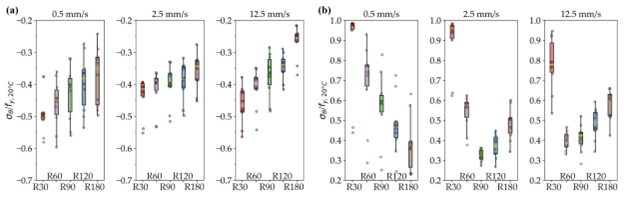
Figure 4. Maximum stress utilisation at mid-span with different FRR – R30, R60, R90, R120 and R180 for all beams under various travelling fire spread rates (mm/s) – 0.5, 5.0 and 12.5: (a) Compression; and (b) Tension.
Conclusions
To properly apply the travelling fire method in performance-based structural fire design, it is crucial to set design parameters within physically meaningful ranges. This is particularly important for parameters such as the fire spread rate and fuel load density, which significantly influence both the thermal and structural responses. In steel-composite structures, the global structural response or potential failure mechanisms can be fundamentally changed by the application of fire protection materials of varying thicknesses, and fire spread rates. This change is due to the lag in heat transfer caused by fire protection, particularly during travelling fires that induce heating and cooling cycles. Therefore, it is suggested to consider various travelling fire scenarios in the design process, such as a “fast” travelling fire with a very high resultant HRR (e.g., 12.5 mm/s with 38 MW) and a “slow” travelling fire with a modest resultant HRR (e.g., 0.5 mm/s with 1.5 MW), to ensure adequate structural resistance.
References
[1] Clifton, G.C. (1996). Fire models for large firecells. HERA report R4-83. HERA Publications, New Zealand.
[2] Stern-Gottfried, J. & Rein, G. (2012). Travelling fires for structural design-Part I: Literature review. Fire Safety Journal, 54:74-85. https://doi.org/10.1016/j.firesaf.2012.06.003
[3] Stern-Gottfried, J. & Rein, G. (2012). Travelling fires for structural design-Part II: Design methodology. Fire Safety Journal, 54:96-112. https://doi.org/10.1016/j.firesaf.2012.06.011
[4] Rackauskaite, E., Hamel, C., Law, A. & Rein, G. (2015). Improved Formulation of Travelling Fires and Application to Concrete and Steel Structures. Structures 3:250–260. https://doi.org/10.1016/j.istruc.2015.06.001
[5] Heidari, M., Kotsovinos, P. & Rein, G. (2020). Flame extension and the near field under the ceiling for travelling fires inside large compartments. Fire and Materials 44:423–436. https://doi.org/10.1002/fam.2773
[6] Dai, X. (2017). An extended travelling fire method framework with an OpenSees-based integrated tool SIFBuilder. PhD thesis, University of Edinburgh.
[7] Dai, X., Welch, S., Vassart, O., Cábová, K., Jiang, L., Maclean, J., Clifton, G.C. & Usmani, A. (2020). An extended travelling fire method framework for performance-based structural design. Fire and Materials 44:437–457. https://doi.org/10.1002/fam.2810
[8] Kirby, B.R., Wainman, D.E., Tomlinson, L.N., Kay, T.R. & Peacock, B.N. (1999). Natural fires in large scale compartments. International Journal on Engineering Performance-Based Fire Codes 43-58.
[9] Nan, Z., Dai, X., Chen, H., Welch, S. & Usmani, A. (2022). A numerical investigation of 3D structural behavior for steel-composite structures under various travelling fire scenarios. Engineering Structure 267:114587. https://doi.org/10.14264/a1068ab
[10] ASFP. (2014). Fire protection for structural steel in buildings (The Yellow Book). 5th Edition. Association for Specialist Fire Protection.