
View the PDF here
The Importance of Data in Fire Safety Engineering
By: Michael Spearpoint, OFR Consultants, UK
Kees Both, Etex, The Netherlands
Simón Santamaria, Hydrock Consultants Ltd, UK
Andrea Lucherini, Slovenian National Building and Civil Engineering Institute (ZAG), Slovenia
Bjarne P. Husted, Danish Institute of Fire and Security Technology, Denmark
Roy Weghorst, Kingspan, The Netherlands
Background
On 15th February 2024, Lund University hosted the 9th International Master of Science in Fire Safety Engineering (IMFSE) Day where the topic was “The importance of data in fire safety engineering”. The event provided a unique networking and discussion opportunity for more than 50 IMFSE students, several academics from the core partner institutes (Lund University, The University of Edinburgh, Universitat Politecnica de Catalunya, and Ghent University), and delegates from associated partners and contributors. The day included presentations by four speakers followed by a panel discussion moderated by Dr Enrico Ronchi that also included contributions from the students and other attendees. The presentations aimed at covering a wide range of expertise and points of view related to fire safety engineering, from engineering consultancy companies, product manufacturers, researchers, and academics. This article summarises the key points from the presentations and some of the ensuing panel discussion.
Fire safety engineering data
From a broad perspective, when considering data, a number of concepts are important. Firstly, what is meant by data and how data can be used to generate information that in turn becomes knowledge and then wisdom (the data – information – knowledge – wisdom, or DIKW, pyramid). For example, data may be a simple as a set of heat release values, but it would then be important to consider how it was collected and what these values represent. The associated information might be that these are peak heat release values obtained through a specific processing of the raw measurements of free burn experiments from a sample of the population of single-seat upholstered chairs available in a certain market (Figure 1). The wisdom then relates to how an engineer might use this knowledge to make a design decision or how a regulator may decide to include this knowledge in a standard or code.
As another example, data might refer to the amount, location and other characteristics of buildings throughout a city, a country or even an entire continent, which need to be considered for certain aspects of building codes (or the perceived lack of proper compliance). Furthermore, if the data is collected following a large-scale intervention, resulting from the identification of improper design and construction practices which introduced an unacceptable risk to the occupants of these buildings (such as the post-Grenfell Tower construction environment in the UK), then the data collected could be used to assess the consistency, accuracy, efficiency and efficacy of the methodologies deployed for these technical assessments. This, however, would require the relevant data (depth, scope, detail) to be gathered, which highlights the importance of early decisions as part of the data-gathering process. The potential of data to be transformed into wisdom is inherently linked to its quality, which can only be defined by the context around its application. Both examples illustrate the broad spectrum that exists related to data, and hence the wider related discussion on data gathering, data management, data analysis, etc.
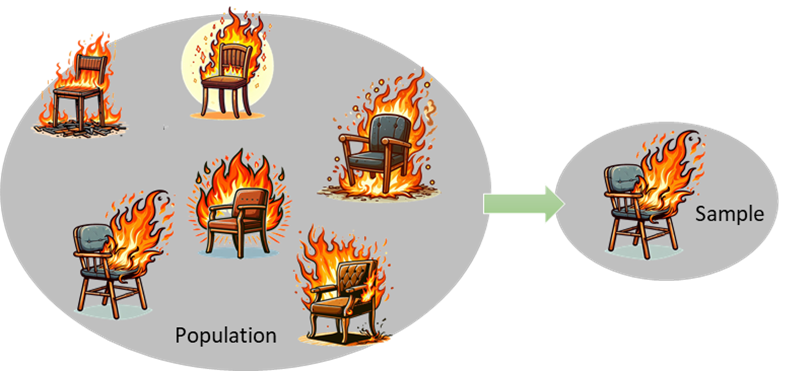
Figure 1. Sample data from a population.
The importance of distinguishing different types of data was emphasized. In fire safety engineering, ‘data’ is typically referred to as information and numbers collected together for reference or analysis. Accordingly, ‘data’ are collected using different technology and equipment which enable their quantification and treatment. In fire safety engineering, ‘data’ are usually associated with the quantifications of a range of physical quantities. The most obvious example is the collection of empirical data through experiments, which are usually analysed and processed to create and validate mathematical and physical models. On the contrary, the speakers have underlined the importance of separating ‘real data’ from ‘synthetic data’. Synthetic data are generally defined as information that is artificially generated rather than produced by real-world events. These are typically created by algorithms and different types of models and sub-models, but they are intrinsically limited by the range of data for which the models and sub-models were created and validated, starting from ‘real data’. This distinction is becoming more relevant with the advent and extensive use of machine learning techniques and artificial intelligence.
Data from experiments and standardized tests
Mundfrom et al. [1] report that there are various rules of thumb for minimum sample size that range “…from 3 to 20 times the number of variables and absolute ranges from 100 to over 1,000”. In the context of fire safety engineering, standardized (fire) tests have sampling rates of three to six replicates, e.g. ISO 5660-1 (cone calorimeter) typically prescribes three replicates but could be six repeats in some cases, while BS 476-7 (flame spread) required five of six replicates to be valid to allow for a classification. Four replicates of each material were used in the ASTM E-84 (Steiner tunnel) inter-laboratory precision and bias assessment. However, when assessing fire safety considerations for the design of the Channel Tunnel, it was only viable to burn two different cars in the laboratory [2]. A discussion on sample size and uncertainty is very much pertinent and remains relevant to modern fire science [3].
The presentations illustrated how the governing physics in experiments, and the limitations of the measurements, dictate the value of the data derived from experiments. Extending the application of such data to situations in which other physics play a significant, or even dominating, role should best be avoided, or only done with extreme care, although it is – perhaps unfortunately – actually common practice across the fire safety industry and rarely recognized as an important limitation. Arguably, data derived from so-called standardised fire tests may very well be of limited value. A way forward was also shown moving towards more advanced used of the standardised equipment, through variations in e.g. heat load, test specimen sizes (or orientation), and instrumentation. It may be evident that in doing so, generating additional data, may impact the compliance classification of the products investigated, which is an issue that needs further discussion.
The element of ethics was also discussed, and linked to it, there was a notion of ‘trust worthiness’. Related to the latter is an example on fire testing doors (Figure 2), which was repeated after failing to reach a compliance target of 30 min.
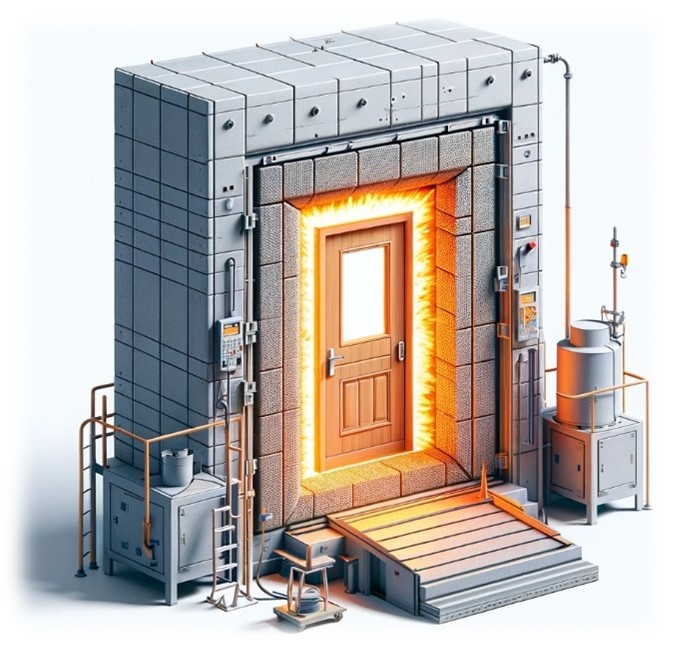
Figure 2. Fire door undergoing a standard furnace test (created by AI through OpenAI's DALL-E service).
The example aimed at provoking a discussion on the relevance - or better: value - of the (hidden) data of such ‘failed tests’, compared to a single ‘lucky shot’. Expanding the discussion on ‘trust’, it appears evident that some form of oversight and third party (independent) engagement in data gathering (say: fire testing) is essential for building up confidence in the data. Without such confidence, moving up the DIKW pyramid seems impossible (or leading to the opposite of wisdom: folly). In the sector of compliance fire testing, so-called notified bodies, exposed to independent accreditation, take up the role of the third party that gathers data.
Quantity, quality, relevance, and resources
The above discussion leads to what will be called here the 2Q2R tenant of quantity, quality, relevance, and resources; is there a is sufficient amount of relevant data, that has sufficient quality and there are the resources (e.g., time, computational capacity, appropriate analysis techniques) to do something useful with that data. It was suggested that many individuals have collected data, only to never had the capacity to transform it into information that could then become knowledge. However, it was pointed out that the act of collecting data in itself can serve a useful purpose, enhancing the individual’s knowledge, even if the data is not immediately or even never used at all.
Fire safety engineers can obtain data from various sources whether that be historical records, standardised tests, contemporary surveys, or ad-hoc experiments. Each of these will differ according to the 2Q2R tenant. Case studies were used to illustrate these points: the quality of data recorded in sprinkler activation incidents reports [4]; the insufficient quantity of data to carry out a machine learning exercise on façade fire events [5]; the large volume of data on smoke detector battery performance on which on a preliminary analysis has ever been undertaken [6]; and the likely irrelevance of the colour of the cars burned during the Channel Tunnel study [2].
ISO TC92, subcommittee 4 (fire safety engineering), is starting a discussion aimed at the proper articulation of the demands of fire safety engineers related to (standardized) fire testing. Through perhaps relatively simple cost-efficient modifications (e.g., changes in heat load, test specimen sizes, additional measurements), much more relevant data could be obtained from fire tests. This does require a thorough discussion on the ownership of and liabilities attached to obtaining such data.
Panel discussion
The audience were asked to propose topics for the panel discussion although time precluded covering every suggestion. The various topics that were discussed by the panel were:
· How can data be ‘trusted’ especially when it has not been collected by ourselves?
· What do we do when do not have enough or access to data?
· how is the transparency of data and data collection ensured?
· What are the future fire safety engineering data going to look like?
It is beyond the scope of this short article to address the above questions, but these are likely relevant questions that many readers have already had to contend with.
Conclusions
What is clear is that a large amount of data can be beneficial for conducting comprehensive analyses and making informed decisions. However, it is crucial to consider the quality and relevance of the data in which a balance is struck between the volume of data and the ability to derive meaningful conclusions. DIKW might be seen as a continuous improvement circle, where at least part of the wisdom leads to filling of gaps in data (and subsequent information and knowledge). Such self-learning could lead to improved (standardized) testing, as well as generate the need for new data, or re-use of existing data, for other purposes. This is schematically introduced in Figure 3.
Collecting and using data can have additional privacy, commercial and ethical considerations. As to the point of ethics, the panel could only scratch the surface, and there is certainly an appetite to address this in a follow-up event.
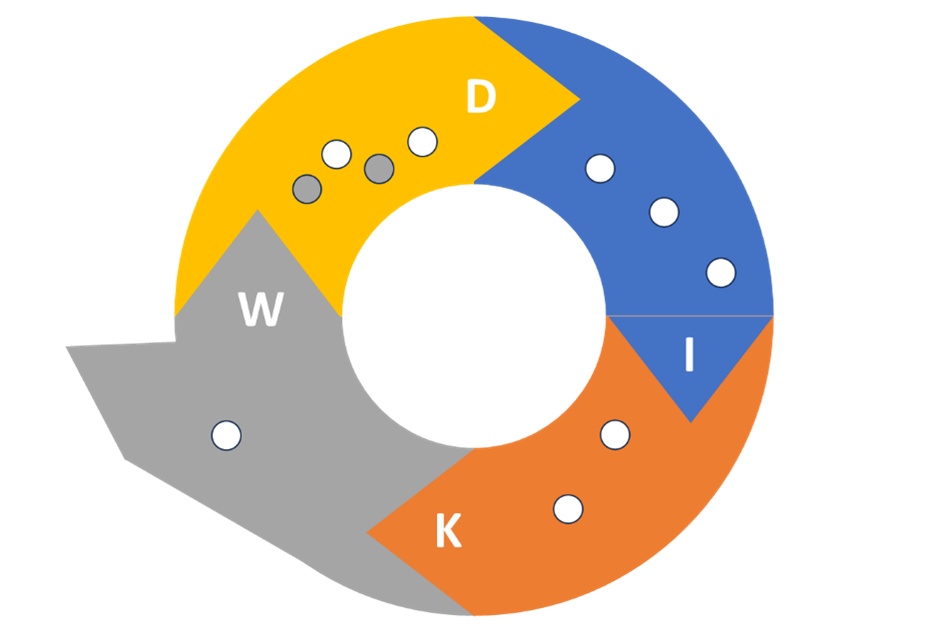
Figure 3. Continuous improvement of wisdom – variant of the DIKW model.
References
[1] D. J. Mundfrom, D. G. Shaw, and T. L. Ke, ‘Minimum sample size recommendations for conducting factor analyses’, International Journal of Testing, vol. 5, no. 2, pp. 159–168, Jun. 2005, doi: 10.1207/s15327574ijt0502_4.
[2] M. Shipp and M. Spearpoint, ‘Measurements of the severity of fires involving private motor vehicles’, Fire and Materials, vol. 19, no. 3, pp. 143–151, 1995, doi: 10.1002/fam.810190307.
[3] D. Morrisset, G. Thorncroft, R. Hadden, A. Law, and R. Emberley, ‘Statistical uncertainty in bench-scale flammability tests’, Fire Safety Journal, vol. 122, p. 103335, Jun. 2021, doi: 10.1016/j.firesaf.2021.103335.
[4] K. Frank, M. Spearpoint, and N. Challands, ‘Uncertainty in estimating the fire control effectiveness of sprinklers from New Zealand fire incident reports’, Fire Technol, vol. 50, no. 3, pp. 611–632, May 2014, doi: 10.1007/s10694-012-0297-2.
[5] M. J. Spearpoint, I. Fu, and K. Frank, ‘Façade fire incidents in tall buildings’, CTBUH Journal, no. II, pp. 34–39, 2019.
[6] M. J. Spearpoint and J. N. Smithies, ‘The performance of mains-powered residential smoke alarms with a backup energy source’, presented at the 12th International Conference on Fire Detection, AUBE 2001, Gaithersburg, USA, 2001.