
View the PDF here
New standards for performance-based design in Sweden – Better or worse for PBD?
By: Nils Johansson, Department of Fire Safety, Lund University, Sweden
Context
In July 2024, the new, reformed, building regulations were presented in Sweden. These new rules, which will come into effect in July 2025, introduce an entirely new regulatory model and significant changes in several areas, particularly regarding safety in case of fire. One of the major changes is the withdrawal of the previous general recommendation for performance-based design of fire protection in buildings. These recommendations are now to be replaced by a number of new (and existing) standards. But how significant is this change compared to the current regulations? And is it a step forward, or a step backwards, for PBD in Sweden? In this article, we will attempt to briefly answer these questions.
A short introduction
Let's start from the beginning. Performance-based design (PBD) of fire safety in buildings has been a crucial part of the Swedish building regulations since the introduction of Boverket's Building Regulations (BBR) in 1994. Prior to this, the regulations were based on prescriptive requirements, but with BBR, the principle shifted to a system based on performance requirements and guidance/examples of solutions. The purpose of the change in regulation was to encourage more development within the building industry and innovative solutions without compromising crucial aspects, such as fire safety.
From 1994 to 2011, performance-based design of fire protection in buildings was not regulated in any formal way except in non-mandatory guidelines such as Boverket's report "Evacuation Design" and various other handbooks on the subject. Consequently, the execution, design scenarios, and acceptance criteria for different solutions varied widely within the industry. This inconsistency was regarded as a problem by the industry and the responsible authority, Boverket, who responded by more clearly regulating performance-based design with the transition to BBR 19 in 2012. This transition also involved a restructuring of the building regulations, making it mandatory to apply performance-based design if the general recommendations was deviated from. The purpose was to create healthier competition, i.e., competition focusing on other aspects than safety level, and to clarify the minimum requirements within the regulations. In other words, the goal was to promote a more uniform application of the regulation, especially when the users applied performance-based design.
The overall purpose of this previous change has mostly been regarded as fulfilled. The safety level in different performance-based solutions is much less varied now than before the change. However, the regulations have been criticized for being overly exhaustive. While some of the performance requirements have been regarded as overly prescriptive, e.g., the “performance requirement” on fire fighter elevators states that it shall be included in buildings with more than 10 floors, others have been considered too loosely formulated, making compliance difficult to demonstrate. In the latter case, the general recommendations have been seen as the minimum required level, something that may not have been the purpose from the beginning.
To solve the problems listed above, Boverket was given a directive from the Swedish government to reform the regulation once again.
New regulations
Thus, Boverket has revised its building and construction regulations again. The new regulatory model involves the withdrawal of most general recommendations, apart from certain references to standards/industry publications that Boverket considers important to retain. The fundamental principle of this work has been to create a regulatory framework with fewer rules, more clearly formulated performance requirements, together with prescriptive detailed mandatory options that may be used to fulfill the performance requirements. Verification and example solutions, which were previously included in the general recommendations, have been removed to allow the "sector" or "industry" to take responsibility for that part of the regulatory application.
However, Boverket has decided that fire protection of buildings still needs the possibility of performance-based design. This approach enables innovative solutions that are both cost-effective and climate-efficient, and it opens opportunities for architectural designs that do not fit within the prescriptive regulations in the new regulatory model. Thus, designing fire protection through performance-based design remains a fundamental principle within the regulatory framework and all prescriptive rules can be verified through using this approach. However, Boverket will withdraw its general recommendations on how such design should be carried out.
Is it a return of the “wild west” in the Swedish fire protection industry?
As mentioned, Boverket has decided to withdraw its general recommendations on performance-based design of fire protection in buildings, which makes the situation somewhat reminiscent of the period before BBR 19 — a situation that few in the industry were satisfied with. However, to maintain some level of control over how performance-based design is performed, Boverket has chosen to refer to a few new standards, or technical specifications, on the subject, see Figure 1. For example, Boverket has chosen to reference one technical specification, currently in the making, with the wording 'For absolute analysis, acceptance criteria and design loads according to SIS/TS 24837 should be applied.' This means that Boverket continues to define the conditions that must be applied when performance-based design is performed through 'absolute analysis'. Ij such cases , fire protection is not compared with the safety levels outlined in the detailed regulations but is instead designed based on assessments and calculations against fixed criteria.
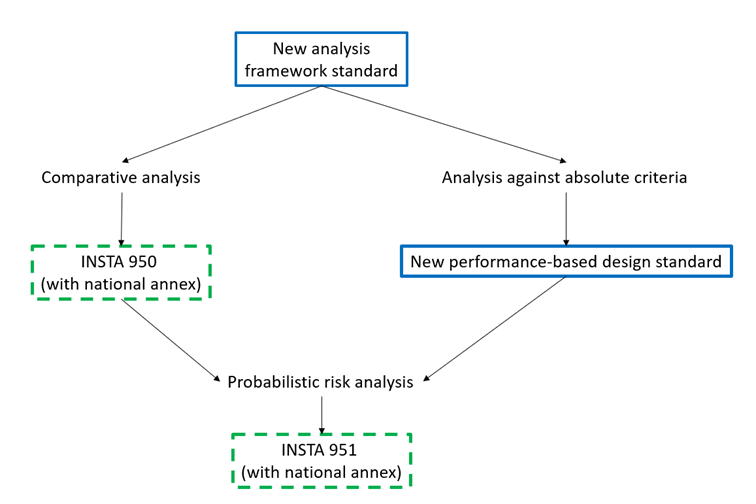
Figure 1. Framework
Within the new technical specification’s guidance is given on such things as the structure of analysis, different analysis models and how to handle uncertainty in different situations. Furthermore, guidance is given on design fire scenarios, acceptance criterions and how different fire protection systems may affect the situation. Thus, the guidance on how performance-based design is to be performed, is similar in the new regulation, but the standard/guideline has been developed within the industry instead of by Boverket.
New standards – An industry effort
The new standards were developed in an industry effort with participation from academia, designers and research/testing institutes. To give guidance on how to develop the standards in the best way, a survey was performed within the industry. The aim of the survey was to identify what parts of the current performance-based design guideline that was good and what areas needed improvement.
Based on the survey, a number of areas were selected as in need of development. In practice, this means that the proposals for the new standards included major changes in relation to the previous guideline within the following areas:
- A new and clearer process for performance-based design in general.
- A new section on performance-based design of load-bearing capacity during fire.
- Adjusted and expanded evacuation parameters (e.g., person flows, pre-evacuation times, etc.).
- A new design fire scenario for evacuation analysis of parking garages.
- Adjusted acceptance criteria for evacuation analysis.
- Clarified criteria for fire spread within buildings.
- A new “simplified” model for analyzing fire spread between buildings.
- Clarified requirements for performance-based design of roof coverings.
In addition to the bullets above, several minor changes and clarifications have been made in various sections. The draft standards were also open to public review during the summer of 2024, giving the industry the opportunity to further influence the content.
With this work, the hope is that these standards will lead to an even greater application of performance-based design in fire protection, thereby contributing to an increased pace of innovation in the construction industry.
Authored by: Axel Mossberg, Bengt Dahlgren Fire Research
Figure 2. Picture by Nils Johansson