Lisa VanBuskirk, PE, SFPE Foundation
This month, the SFPE Foundation concludes a Department of Homeland Security Federal Emergency Management Agency *(FEMA) Fire Prevention & Safety Grant (Fiscal Year 2023), to develop its second Wildland-Urban Interface (WUI) fire risk assessment and mitigation curriculum. Grounded in fire science, the new Advanced Training Topics in WUI Fire Risk Assessment & Mitigation curriculum addresses unmet WUI fire service training needs to reduce community risks.
In our previous experience with a FEMA Fire Prevention & Safety Grant, we learned from the fire service that, as more fire departments are called to engage in WUI fire prevention and protection strategies, training on the basic principles of individual asset protection, such as structural hardening, defensible space, and vegetation management, is increasingly available, but access to advanced WUI fire engineering topics is limited. The SFPE Foundation’s new Advanced Topics in WUI Fire Risk Assessment & Mitigation Curriculum helps close that training and knowledge gap for fire departments across the U.S.
Curriculum Development
The US Fire Administration defines the “5Es” of community risk reduction as: Education, Engineering, Enforcement, Emergency Response, and Economic Incentive. The SFPE Foundation's WUI curriculum brings together the first two E’s, education and engineering. The Advanced Topics in WUI Fire Risk Assessment & Mitigation Curriculum offers engineering tools and resources on three topics, each presented in a 4-hour module:
- WUI Fire Dynamics (Units include Fire and Energy, Heat Transfer and Ignition, and Fire Spread)
- WUI Fire Modeling (Units include Fire Modeling Fundamentals, Wildfire Spread Models, and Plume Dispersion & Impacts of Fire Effluents)
- Human Behavior in WUI Fires (Units include Human Behavior in Fire Fundamentals, Fire Impacts on People, Pedestrian Evacuation Modeling, and Traffic Evacuation Modeling)
While the tools and resources will be familiar to many fire safety engineers and fire service members, the course places them in a WUI context for the first time.
A Curriculum Consultant team developed and refined these topics into three 4-hour training modules over an 18-month period. The selected Curriculum Consultant team included Jamie L. McAllister, PhD, PE, CFI, CSP and Geri Martin, PE, CPEng, CFEI of Halliwell Fire Research-US, and Daniel Nilsson, PhD and Andres Valencia, PhD of the University of Canterbury, New Zealand. As the lead consultant Dr. McAllister explains, “We hoped to bring advanced engineering-based resources and guidance to members of the fire service involved in WUI fire risk reduction and mitigation.”
The Curriculum Consultant team began by conducting a needs assessment workshop with members of the fire service from around the United States to ask questions such as: What training on advanced WUI risk assessment and mitigation topics is currently available to the U.S. Fire Service? How could it be improved? What types of group exercises would be useful?
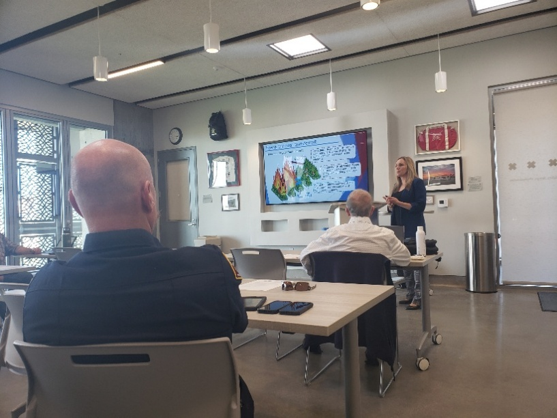
Image: Dr. Jamie McAllister teaching WUI Fire Dynamics in Newport Beach, California.
Based on recommendations from the needs assessment participants, the team developed an initial curriculum that was piloted in September and October 2025 in California, Colorado, virtually to participants across the US, and via an abbreviated presentation during a pre-conference workshop at the 2025 SFPE Annual Conference in Vancouver, BC, Canada. Based on initial feedback, the training materials were adjusted before being piloted in Washington, Texas, and a second virtual convening between January and February 2026.
Group exercises and case studies are included in the curriculum. “These modules provide several practice exercises that allow attendees to apply advanced principles in a group setting,” explains Dr. McAllister. Attendees also appreciated the case studies discussed as a group during the training. As a Wenatchee, Washington pilot participant told us, “I really liked the case studies and some of the discussion we had around them. That really helped me connect the material from the course to a real-life situation, then reflect on my own community.”
Nearly 100 students participated in the two phases of the curriculum pilots, providing valuable feedback on the curriculum, group activities, knowledge check quizzes, and delivery methods. One of the Austin, Texas participants was overheard sharing with colleagues that they imagined themselves using the explanation of WUI fire dynamics in their engagement with property owners the very next day to better explain why defensible space and structural hardening are important. Another Austin participant reflected, “As a wildfire mitigation specialist, it was good to see these [WUI] problems from a more engineering perspective.”
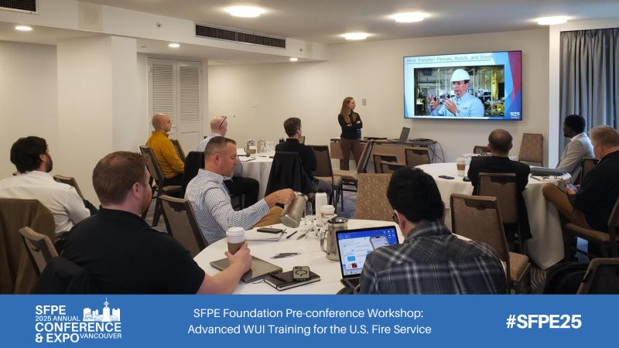
Image: Geri Martin presenting an abbreviated WUI curriculum at the 2025 Annual Conference.
Webinars
The initial needs assessment workshop also identified the value of additional training opportunities beyond the 12 hours of advanced curriculum content. This led to the development of three free, on-demand webinars created exclusively for the SFPE Foundation by subject matter experts. Each webinar compliments the longer Advanced Topics in WUI Fire Risk Assessment & Mitigation Curriculum, allowing viewers to delve into community evacuation planning, emergency communications, and fire and evacuation modeling through lessons learned and real-world examples.
Like the twelve hours of curriculum, the three draft webinars were piloted with an audience of fire service members, WUI researchers/academics, and fire engineering practitioners, including members of the SFPE Foundation’s WUI Working Group. Feedback on the webinar was sought to improve the final version of the webinars and to better understand if viewers found value in the webinars. Each webinar received constructive feedback and compliments such as, "Great explanation and examples from the speaker's own operational experience, including discussion of how they learned from other fires to implement changes in their community before a fire happened to them," from a Community Notification and Evacuation webinar pilot participant. An Effective Notification webinar pilot participant noted, “This webinar provides a strong evidence-based foundation for emergency messaging in WUI events. Its emphasis on plain language, trusted sources, inclusive communication, and post-event messaging aligns well with lessons learned from recent catastrophic fires.” A Fire and Evacuation Modeling webinar participant acknowledged a greater understanding of WUI modeling from the webinar, “I entered the training with several preconceptions and left with a much clearer and more comprehensive understanding of the current practices, applications, expectations, and limitations of community-level fire and evacuation modeling.”
Like the full curriculum, the webinars offer two of the community risk reduction "E's" of Engineering and Education, which can benefit fire service members, as well as fire engineers wanting to learn more about the unique aspects of the WUI problem and potential engineering solutions. Each webinar will award 1-1.5 Professional Development Hours upon successful completion of a knowledge check. The three webinars are available through SFPE’s learning management system:
- · Wildland-Urban Interface: Community-Level Notification and Evacuation Plans (SFPE Foundation) by David Wolf, PhD, Battalion Chief, Golden Fire Department and Joseph Shellhammer, Undersheriff, Larimer County Sherriff's Office
- · Wildland-Urban Interface: Integration of Fire and Evacuation Modelling at Community-Level (SFPE Foundation) by Steve Gwynne, PhD,Professor of Evacuation and Pedestrian Dynamics, University of Greenwich
- · Wildland-Urban Interface: How to Structure Effective Messages (SFPE Foundation) by Erica Kuligowski, PhD, ARC Future Fellow and Principal Research Fellow, Royal Melbourne Institute of Technology
Risk Evaluation
Collecting feedback from the curriculum pilot attendees and webinar viewers was one of the tasks of the Engineering Risk Consultant contracted by the SFPE Foundation. California Polytechnic State University San Luis Obispo's Wildland-Urban Interface (WUI) FIRE Institute was the Engineering Risk Consultant selected for this project. Team members included Frank Frievalt and Margot McDonald, AIA, NCARB, LEED AP of the WUI FIRE Institute, Lonny Simonian, PE, Chris Pascual, PhD, PE and Shantanu Kumar, PhD, of Cal Poly San Luis Obispo, and Denny O'Neil of Wildfire Adapted Solutions.
The Engineering Risk Consultant team evaluated the Advanced Topics in WUI Fire Risk Assessment & Mitigation Curriculum, both from a technical standpoint and to identify the potential risk reduction achieved from the training implementation. Each team member attended one or more pilots, allowing them to better contextualize their own observations and that of the pilot participants. The Engineering Risk Consultant also evaluated the three webinars for technical content, reviewed the feedback and knowledge check questions, and provided recommendations on areas for potential improvement, before the webinars were finalized.
After analyzing an immense amount of data collected on participants’ fire service backgrounds, WUI experience, and performance on the knowledge quizzes taken before and after each module was taught, Cal Poly evaluated the curriculum’s potential to reduce community risk. They concluded that “the curriculum has significant potential to improve wildfire preparedness and risk reduction capacity when delivered to audiences positioned to influence community planning, mitigation, prevention, and preparedness activities.” The training demonstrates strong potential to contribute to risk reduction by:
- · Improving understanding of wildfire hazards and fire behavior.
- · Increasing familiarity with risk assessment methodologies.
- · Strengthening understanding of mitigation strategies and their scientific basis.
- · Improving evacuation planning awareness.
- · Enhancing communication between fire service personnel, engineers, planners, elected officials, and community stakeholders.
- · Supporting evidence-based decision-making regarding wildfire preparedness and resilience.
“With the development of these Advanced WUI Topics courses, the SFPE Foundation continues to expand and deepen our partnership with FEMA, the National Fire Academy, and the U.S. Fire Service,” explains SFPE Foundation Executive Director, Leslie Marshall, PhD. “We remain committed to working with fire service personnel to understand their training needs and to identify and deliver in areas where fire protection engineering research, knowledge, and resources can help close critical gaps and make our communities safer and more resilient.”
Next Steps
The SFPE Foundation now offers both an introductory and an advanced WUI Fire Risk Assessment & Mitigation curriculum for the U.S. Fire Service, which contribute to two of the US Fire Administration’s E’s (Engineering and Education) to reduce community risk. These courses, however, are only valuable when available to fire service members. As Dr. McAllister highlights, “We look forward to future deliveries of this course, as we believe it will have a positive impact on the fire service and its risk reduction and mitigation efforts.”
In the next phase, the SFPE Foundation will seek funding sources and partnerships to bring the advanced WUI fire engineering curriculum to fire service locations across the U.S. If your fire department would like to learn more about the WUI curriculum and how to customize the available training to best fit your Wildland-Urban Interface educational needs, please contact Lisa VanBuskirk, WUI Initiatives Program Manager at lvanbuskirk@sfpefoundation.org